
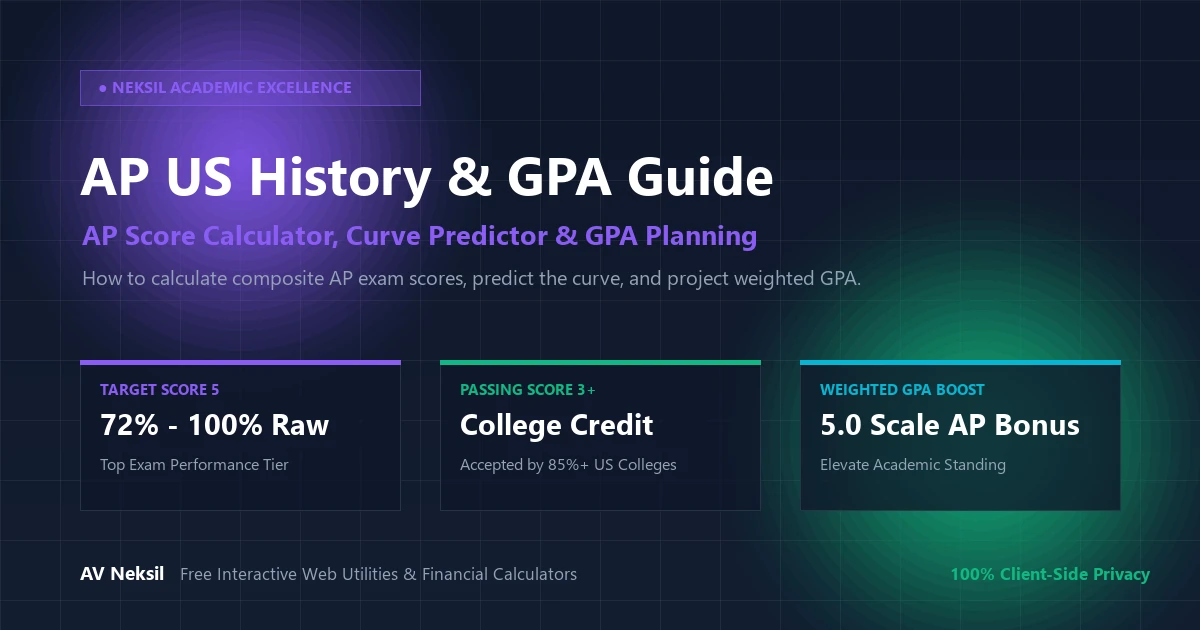
Advanced Placement United States History (APUSH) is renowned as one of the most demanding yet academically rewarding courses in American secondary education. With hundreds of pages of historical analysis, primary source document interpretations, and rigorous timed essay rubrics, students often struggle to understand how their raw practice exam marks translate into the coveted final score of 3, 4, or 5. By using our specialized AP US History Score Calculator, students can model their Multiple Choice and Free Response performance, predict official College Board curves, and understand how AP course grades directly elevate their high school GPA.
Securing a high AP score does more than look impressive on college applications; it unlocks valuable college credit, potentially saving thousands of dollars in university tuition fees. To evaluate the broader academic impact of your honors and AP coursework, students can seamlessly pair exam projections with our interactive GPA Calculator to track weighted versus unweighted academic standing across their high school tenure.
What Is an AP US History Score Calculator and How Is the Exam Scored?
An AP US History Score Calculator is an academic simulation engine that replicates the official composite scoring algorithm designed by the College Board. Rather than treating every question equally, the AP exam weights multiple distinct sections according to a rigorous 130-point composite rubric:
- Section I, Part A: Multiple Choice Questions (MCQ): 55 stimulus-based questions completed in 55 minutes, accounting for 40% of the total composite exam score.
- Section I, Part B: Short Answer Questions (SAQ): 3 written short-answer questions in 40 minutes, contributing 20% of the composite score.
- Section II, Part A: Document-Based Question (DBQ): 1 complex synthesis essay evaluated on a 7-point rubric over 60 minutes, representing 25% of the composite score.
- Section II, Part B: Long Essay Question (LEQ): 1 historical argumentative essay scored on a 6-point rubric over 40 minutes, contributing the final 15% of the composite score.
According to official exam guidelines from the College Board AP Central US History Portal, composite raw points are converted into an official scaled score ranging from 1 to 5 using standardized statistical curve adjustments.
The Composite Scoring Formula: How Your Raw Points Convert
To determine your composite score out of 130 possible points, our calculator applies the standard weighting multipliers:
Composite Raw Score = (MCQ Correct × 1.0545) + (SAQ Score / 9 × 26) + (DBQ Score / 7 × 32.5) + (LEQ Score / 6 × 19.5)
Historical Score Curve Thresholds
While specific cutoffs fluctuate slightly from year to year depending on test difficulty, historical curves closely follow these standard benchmarks:
| AP Scaled Score | Estimated Composite Points (out of 130) | Approximate Percentage | College Credit Qualification |
|---|---|---|---|
| 5 (Extremely Well Qualified) | 98 – 130 Points | ~75% – 100% | Accepted by 99% of top universities for credit or course waiver |
| 4 (Well Qualified) | 82 – 97 Points | ~63% – 74% | Accepted by the vast majority of state flagships and private institutions |
| 3 (Qualified / Passing) | 65 – 81 Points | ~50% – 62% | Official passing score; accepted for general education elective credit |
| 2 (Possibly Qualified) | 48 – 64 Points | ~37% – 49% | Rarely awarded college credit |
| 1 (No Recommendation) | 0 – 47 Points | < 37% | No college credit |
Notice a remarkable insight revealed by the AP US History Score Calculator: you do not need 95% or 100% correct answers to earn a score of 5! Scoring approximately 75% of composite points is generally sufficient to achieve the top grade bracket.
How AP Courses Boost Your High School Weighted GPA
While the May AP exam dictates college credit, your semester classroom grades dictate your high school Grade Point Average. In standard American grading systems, coursework is evaluated on two scales:
- Unweighted GPA (4.0 Scale): Treats all classes equally. An “A” in an introductory gym elective carries the exact same 4.0 weight as an “A” in rigorous AP Chemistry or AP US History.
- Weighted GPA (5.0 Scale): Adds an extra 1.0 grade point bonus for college-level Advanced Placement courses (and 0.5 points for Honors). An “A” in APUSH earns a 5.0, while a “B” earns a 4.0.
Taking multiple AP courses allows high-achieving students to graduate with GPAs of 4.3, 4.5, or higher, drastically increasing competitiveness for selective university admissions and academic scholarships. You can model your semester grades using our free High School and College GPA Calculator.
Four Strategies to Maximize Your APUSH Exam Performance
Students aiming for a score of 4 or 5 should focus their study hours on these high-yield tactical areas:
- Master the 7-Point DBQ Rubric: The Document-Based Question accounts for a massive 25% of your score. Focus on securing the guaranteed points: Thesis (1 pt), Contextualization (1 pt), Document Evidence (2 pts), Sourcing/HIPP analysis (1 pt), and Historical Reasoning/Complexity (1 pt).
- Pace the Multiple Choice Section: You have approximately 1 minute per stimulus question. Read the attribution line (author, source, date) first before reading the stimulus text to immediately anchor the historical time period.
- Review Companion AP Disciplines: Rhetorical reading strategies from AP English Language directly enhance DBQ essay speed, while quantitative skills from AP Chemistry strengthen data interpretation.
- Simulate Full Practice Tests: Take timed 3-hour practice exams and plug your raw sectional scores into the AP US History Score Calculator to track your progress week over week.
Frequently Asked Questions (FAQ)
Answers to common questions from AP students and parents:
What happens if I get a 1 or 2 on the AP exam?
Failing an AP exam does not affect your high school transcript GPA; your high school grade remains intact. Furthermore, you can choose not to send poor AP exam scores to colleges on your official score report.
How is the DBQ scored if I only use 3 documents?
To earn the full 2 points for document evidence on the DBQ, you must support your argument using the content of at least four documents. Using three documents only qualifies for 1 evidence point.
Are the Neksil AP and GPA calculators completely free?
Yes. The AP US History Score Calculator and GPA Calculator on Neksil are 100% free with no registration or fees.
Conclusion: Achieve Academic Excellence with Neksil
Preparing for college-level exams requires strategic study habits and clarity on how your efforts translate into final results. Use our free AP US History Score Calculator and GPA Calculator today to optimize your test preparation, target a score of 5, and build an exceptional academic transcript.