In the modern subscription economy, scaling a software business profitably is impossible without rigorous unit economics. While top-line Annual Recurring Revenue (ARR) often captures venture headlines, true enterprise value is dictated by capital efficiency: how much it costs to acquire a customer, and how much gross margin that customer yields over their lifetime. By deploying our interactive SaaS LTV CAC Calculator, founders, finance leaders, and product operators can calculate Customer Lifetime Value (LTV), determine Customer Acquisition Cost (CAC), and uncover their exact CAC Payback horizon with granular precision.
Whether you are bootstrapping a micro-SaaS, engineering specialized AI tools while tracking infrastructure spend with our AI API Cost Calculator, or preparing financial documentation for an institutional Series A or B fundraise, understanding your LTV-to-CAC dynamics separates sustainable market leaders from capital-burning failures.
What Is a SaaS LTV CAC Calculator and Why Is It the North Star of Software?
A SaaS LTV CAC Calculator evaluates the return on investment of your go-to-market engine. It pits the total lifetime gross profit generated by a customer against the total blended sales and marketing expenditures required to convert that customer from an initial lead into a paying subscriber.
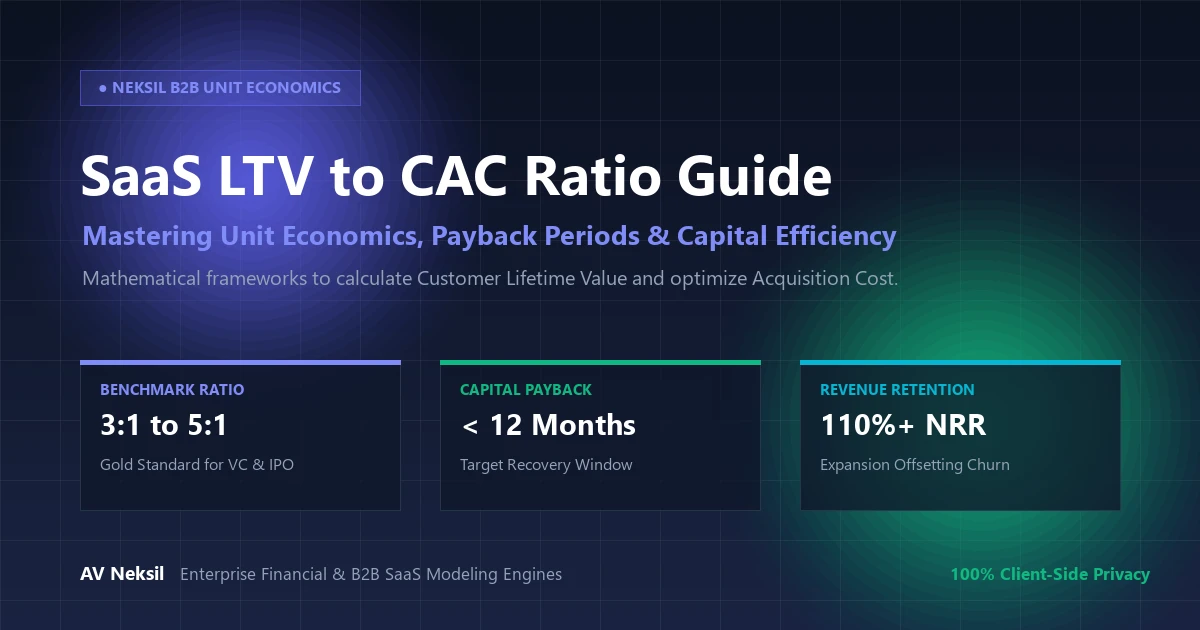
According to venture benchmarks published in the Bessemer Venture Partners (BVP Cloud Index), top-quartile cloud companies consistently maintain an LTV:CAC ratio between 3:1 and 5:1 with a CAC payback period under 12 months. Ratios outside this optimal corridor signal critical structural inefficiencies:
- Ratios Below 2:1: The business is burning excessive capital on marketing or suffering from aggressive customer churn; continued acquisition risks insolvency.
- Ratios Above 6:1: While ostensibly profitable, this often indicates the company is under-investing in marketing, allowing aggressive competitors to capture market share.
The Core Mathematical Formulas Governing SaaS Unit Economics
Our online calculation engine leverages four fundamental mathematical equations recognized by Silicon Valley investment banks and financial analysts:
1. Customer Acquisition Cost (CAC)
CAC represents the total fully-loaded expense required to sign a single net-new customer:
CAC = (Total Sales Salaries & Commissions + Total Paid Ads + Marketing Software & Overhead) / Total New Customers Acquired
2. Customer Lifetime Value (LTV)
Crucially, true LTV must account for **Gross Margin**—not just top-line revenue. Counting raw subscription fees without subtracting hosting, customer success, and payment processing expenses grossly overstates lifetime value:
LTV = [ (Average Revenue Per User per Month (ARPU) × Gross Margin %) / Monthly Logo Churn Rate ]
3. The LTV to CAC Ratio
The core health multiplier is simply:
LTV:CAC Ratio = LTV / CAC
4. CAC Payback Period (Months to Cash Breakeven)
This metric measures how many months a customer must remain subscribed before their gross profit completely repays the capital spent to acquire them:
CAC Payback Period (Months) = CAC / (Monthly ARPU × Gross Margin %)
Industry Benchmarks: What Does a “Good” LTV:CAC Look Like?
The health of your unit economics dictates both operational sustainability and venture fundraising valuations. The table below outlines industry benchmarks across software stages:
| LTV:CAC Ratio | Diagnostic Health Status | Typical CAC Payback | Strategic Action Plan |
|---|---|---|---|
| < 1.0x | Value Destruction | Never (Customers churn before breakeven) | Halt paid ads immediately. Fix onboarding, reduce churn, or increase pricing. |
| 1.0x – 2.0x | Marginal Viability | 18 to 28 Months | Capital intensive; working capital is strained without heavy external debt or equity. |
| 3.0x – 5.0x | Ideal / High-Growth Gold Standard | 6 to 12 Months | Aggressively pour capital into sales and marketing; highly attractive to institutional investors. |
| > 5.0x | Super-Efficient (Under-Investing) | < 5 Months | Opportunity cost risk. Increase ad budgets and sales headcount to capture broader market share. |
Five Levers to Dramatically Improve Your SaaS Unit Economics
If your results from the SaaS LTV CAC Calculator reveal a compressed ratio, focus on these five operational levers:
- Implement Value-Based Pricing Tiers: Flat-rate pricing caps your expansion revenue. Moving to usage-based metrics (tokens, seats, API calls) enables your best customers to expand their spending automatically over time.
- Squeeze Customer Churn: Because churn sits in the denominator of the LTV equation, reducing monthly churn from 5% to 2.5% doubles your Customer Lifetime Value overnight without changing pricing or sales conversion.
- Incentivize Annual Upfront Contracts: Offering a 15% discount for annual upfront billing eliminates CAC payback lag, supplying immediate cash flow to finance customer acquisition. Manage contract invoicing seamlessly with our Invoice Generator.
- Optimize Cloud Infrastructure Costs: High server, GPU, and API overhead crushes your gross margin. Auditing token usage with tools like our AI API Cost Calculator ensures margins remain above the 75%+ software threshold.
- Invest in Organic Inbound Channels: Relying exclusively on paid Google and LinkedIn ads inflates CAC. Building organic search authority with free engineering-as-marketing tools drastically lowers your blended acquisition cost.
Step-by-Step Guide: How to Model Your Metrics on Neksil
Evaluating your startup’s economics is rapid and straightforward:
- Navigate to the Tool: Open the free SaaS LTV CAC Calculator on Neksil.
- Input Acquisition Metrics: Enter your monthly marketing spend, sales payroll, and total new customers signed.
- Enter Revenue and Retention Parameters: Specify your average monthly subscription price (ARPU), gross margin percentage, and monthly customer churn rate.
- Inspect the Instant Dashboard: Review your calculated LTV, CAC, LTV:CAC ratio, and CAC payback period, along with automated health diagnostics.
Frequently Asked Questions (FAQ)
Common questions from software executives and operators:
Should I include Customer Success costs in CAC or COGS?
Customer Success managers focused on onboarding, retention, and support should be allocated to Cost of Goods Sold (COGS), reducing your Gross Margin. Only customer success staff with explicit quotas for net-new upsells or cross-sells should have that fractional compensation counted in CAC.
What is Net Revenue Retention (NRR) and how does it affect LTV?
Net Revenue Retention measures the percentage of recurring revenue retained from existing customers over a period, factoring in downgrades, churn, and expansion upsells. If your NRR exceeds 100% (ideal SaaS companies achieve 110% to 130%), your customer base expands organically, driving theoretical LTV toward infinity.
Is the Neksil SaaS LTV CAC Calculator free for commercial use?
Yes. All modeling suites on the Neksil Platform are 100% free for commercial and internal planning. No sensitive business metrics are ever stored or shared.
Conclusion: Drive Predictable, Capital-Efficient Growth
Achieving venture scale or bootstrap sustainability demands relentless focus on the math beneath your business. Knowing your exact customer acquisition costs and lifetime returns empowers you to make aggressive, confident investments in growth. Visit the free SaaS LTV CAC Calculator today to diagnose your startup’s financial engine and unlock superior enterprise value.